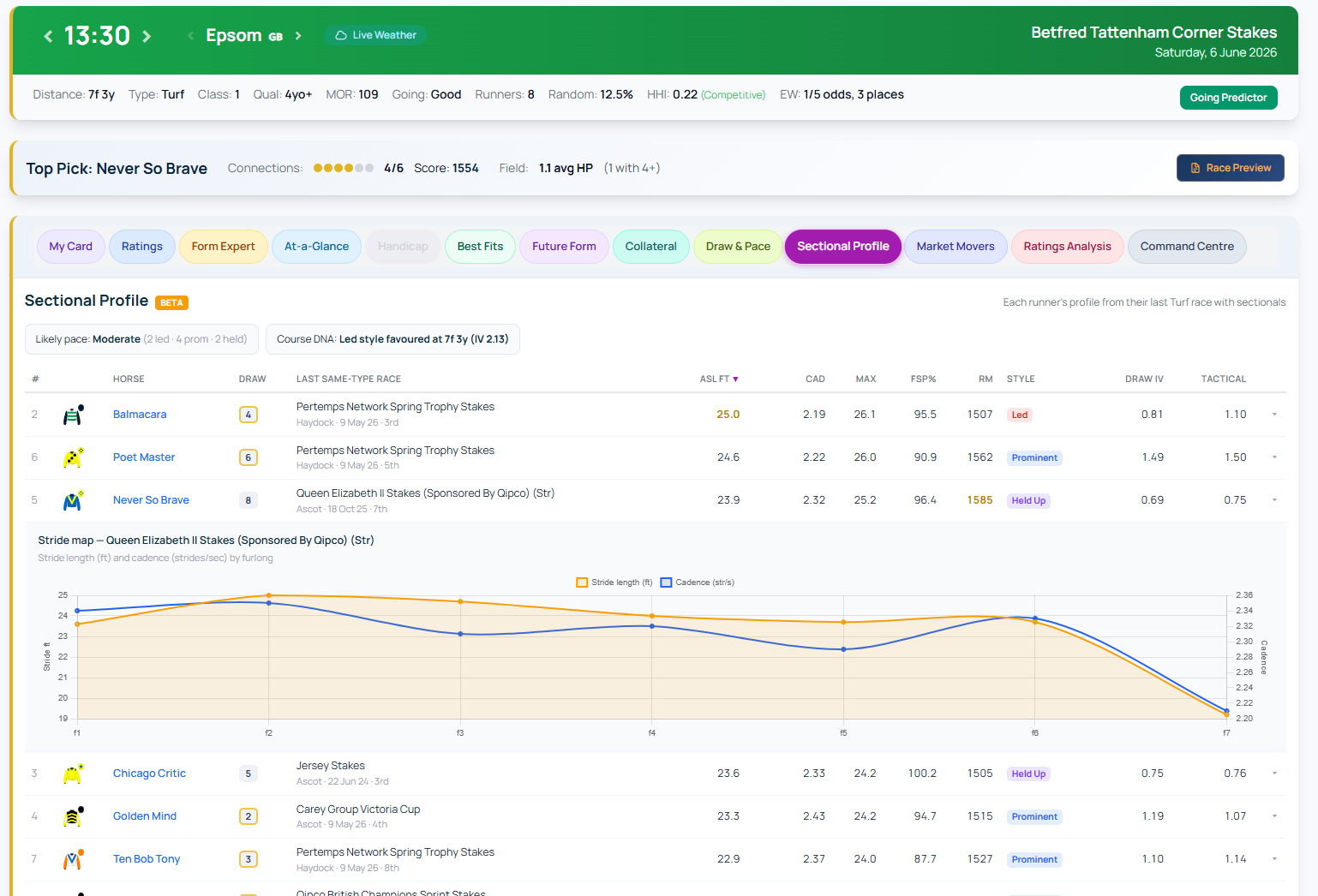
Sectional Profile: How to decode stride and pace in seconds
The Sectional Profile tab on every RaceMetrics racecard gives you a snapshot of how each runner actually moves. Rather than relying on form lines or trainer notes, you see the mechanics: stride length, cadence, and finishing speed from each horse's most recent race over the same surface and type.
This single view combines stride analysis, sectional data, and draw assessment — the kind of detail usually reserved for feature races — for every runner in your race.
The logic: speed = stride length × cadence
A horse moves faster in two ways: by covering more ground with each stride, or by quickening the rhythm. The balance between these tells you what kind of galloper you are looking at.
True stayers settle into a long, low, even rhythm early and have energy to quicken at the finish. Sprinters operate differently: shorter strides, higher cadence, speed through the middle of the race. Neither profile is inherently superior — what matters is fit: does this horse's natural style suit today's trip, ground, and likely pace?
Reading the numbers
- ASL — average stride length in feet (typically 22–26ft). Long strides suggest class and stamina; short ones often indicate a speed type or a horse under pressure.
- Cad — cadence, in strides per second (usually 2.0–2.4). High cadence with short stride: speed horse. Low, even cadence over distance: a relaxer and stayer.
- Max — peak stride length. A wide gap between Max and ASL means the horse had another gear available when asked.
- FSP% — finishing speed percentage. Above 100% means genuine acceleration late; below 100% suggests it was slowing, which may simply reflect a hard race or stiff climb.
- Style — run-style (Led, Prominent, or Held Up) based on recent sectional history, contextualised by today's draw and pace dynamics.
The data is drawn from each runner's most recent race of the same type — Turf, All-Weather, Chase, Hurdle, or NHF — so profiles are always comparative and current.